Reading Your First Birth Chart: The 5 Things to Look At Before Anything Else
Lagna, Moon, Sun, the 7th house, and Saturn — the five anchors of kundli reading. A beginner's map that skips the overwhelm.
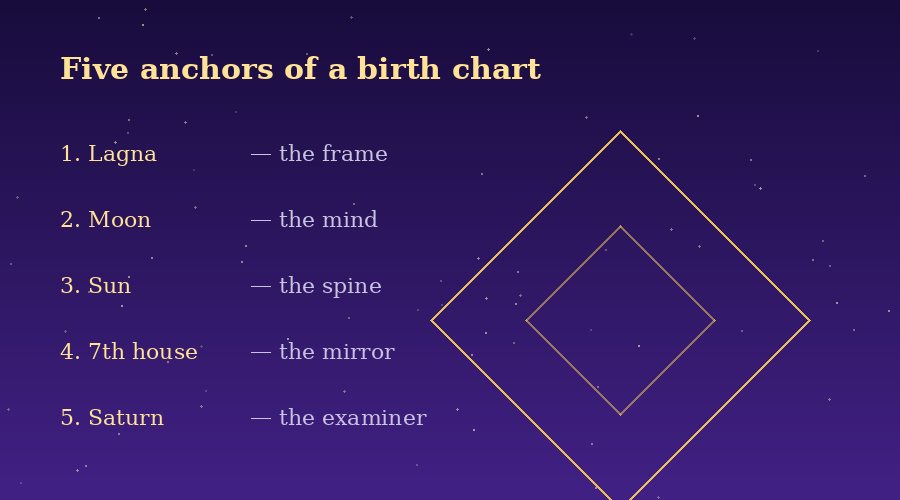
A full kundli is a dense mandala of twelve houses, nine grahas, twenty-seven nakshatras and a dozen divisional charts — enough to freeze any beginner. After decades of teaching, I can tell you the secret: you only need five anchors to read eighty percent of a chart. Master these, and the rest is refinement.
1. The Lagna (Ascendant) — the Frame
Everything hangs on the sign rising at birth. The lagna sets the house numbering, and the house topics — career, marriage, health — attach to it. A person with Cancer lagna wears their Moon-ness in their body; a Leo lagna enters every room first. Read the lagna lord's condition first: where it sits, who aspects it, how strong it is. A happy lagna lord carries an entire chart.
2. The Moon — the Mind
If the lagna is the frame, the Moon is the weather inside. Its sign sets the emotional climate; its nakshatra sets the instinctive style; its strength (waxing or waning, bright or dark) measures resilience. Most of what people call "personality" is Moon. This is why Vedic dashas run from the Moon — time itself is measured by the mind's weather.
3. The Sun — the Spine
Father, authority, vitality, the will to exist. A strong Sun stands tall in life; a weak one keeps negotiating with self-doubt. Check the Sun's house and sign — in the 1st or 10th it lifts the whole chart; in the 6th or 12th, the native must consciously build confidence.
4. The 7th House — the Mirror
Marriage, yes — but also every serious partnership: business allies, the public, the version of yourself that only others can show you. Read the 7th lord, planets in the 7th, and Venus (the natural karaka). A clean 7th with a supported lord is worth more than any guna total.
5. Saturn — the Examiner
Wherever Saturn sits, life eventually demands structure. Saturn in the 4th: home and peace must be built, not expected. In the 10th: career arrives late but stays. Saturn is the slow graha — its placement marks the chart's long-term homework, the area where shortcuts expire.
The Order of Operations
When I open an unknown chart, my eyes move in this exact order: lagna → lagna lord → Moon → Sun → 7th house → Saturn. Five stops, two minutes. Only then do I open divisional charts, dashas, transits. Beginners do the opposite — drowning in details before touching the skeleton.
And a discipline worth building early: say the chart's one-sentence summary aloud before adding anything. "Cancer lagna, strong Moon in Taurus, Sun in the 10th, clean 7th, Saturn in the 6th — a feeling-led achiever whose partnerships support rather than drain, working off debt through service." If your summary needs thirty clauses, you are listing, not reading.
Frequently Asked Questions
Which chart style is best — North Indian or South Indian?
They carry identical information in different layouts. Learn one; the other takes an afternoon.
Do I need divisional charts (varga) as a beginner?
Not for a year. The rashi chart (D-1) contains the whole story; vargas are magnification, not new chapters.
How long before I can read charts for friends?
With the five-anchor method: a few months of daily practice on fifty charts. Traditional apprenticeships take years — but useful reading comes much sooner.
Generate your chart free and practice the five anchors on the one chart that matters most — yours: free kundli calculator.