Why Your Mood Follows the Moon: Amavasya, Purnima and the Logic of Tithis
The lunar logic behind India's most-observed days — what Amavasya and Purnima actually mean, why Ekadashi keeps appearing, and how tithis differ from dates.
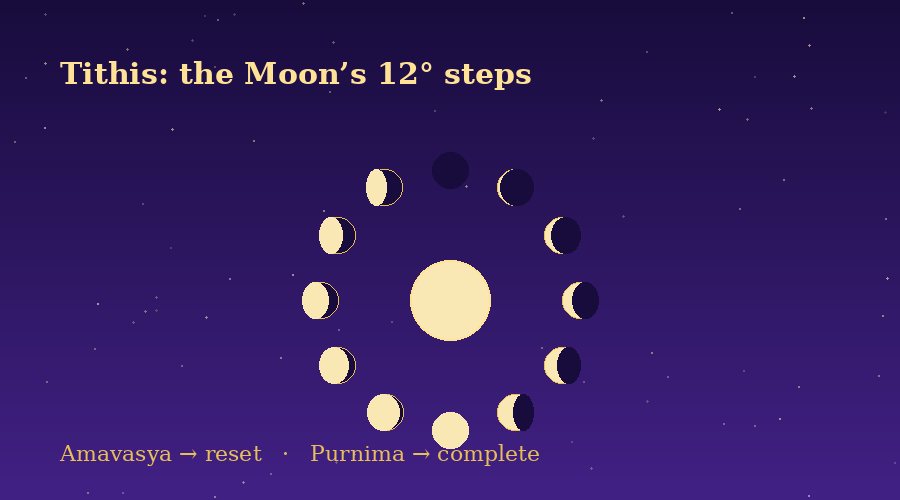
Two days a month, something quiet happens across India: on Amavasya, temples fill with families remembering their ancestors; on Purnima, lamps float on rivers and sweetshops run out of kheer. These are not random customs. They are the visible surface of a lunar calendar so precise that it predicts moonrise to the minute — and, if you pay attention, your own moods along with it.
The Difference Between a Date and a Tithi
The Western calendar counts sunrises. The Hindu calendar counts the Moon's distance from the Sun. Each tithi is a 12-degree step in that elongation — the Moon gains on the Sun by roughly 12° a day, and each step has a name and a character.
This is why festivals move: Diwali is Kartik Amavasya — the exact new moon — not "November 12th". When the tithi shifts, the festival shifts. The calendar follows the sky, not the spreadsheet.
Amavasya: The Day of the Ancestors
New moon. The sky's darkest night, and in tradition, the day when the veil between the living and the lineage is thinnest. Families perform shraddha — rituals of gratitude to parents and grandparents no longer present.
But Amavasya is not only mourning. It is the monthly reset: the old lunar month dissolves, debts to the past are acknowledged, and the new cycle begins unseen. Practically, many experience low energy on Amavasya — the tradition's advice is simple: rest, reflect, don't start major things.
Purnima: The Day of Completion
Full moon — the tithi of fullness and gratitude. Purnima carries some of the calendar's most beloved observances: Guru Purnima, Sharad Purnima with its moonlit kheer, Kartik Purnima's Dev Deepawali.
Energetically it is Amavasya's mirror: high tides, full energy, celebration. The tradition suggests the opposite schedule — complete things on Purnima, release them on Amavasya.
Why Ekadashi Keeps Appearing
Between the two great poles sits Ekadashi — the 11th tithi, appearing twice a month, each with its own name and story. The practice is an upavasa: a "sitting near" — fasting or light eating, prayer, and a break for the digestive system.
Twenty-four Ekadashis a year, each attached to a Vishnu legend. The most famous, Nirjala Ekadashi, falls in the height of summer — a waterless fast that tradition says compresses the merit of all twenty-four.
The Honest Science Corner
What does astronomy say? The Moon's pull moves oceans — and the human body is mostly water, so the idea that moon phase and mood correlate is neither crazy nor proven. The careful position: tithis are an observed rhythm of collective life — millions of people resting, fasting and celebrating on the same lunar beats creates a real social tide, whatever the mechanism.
Frequently Asked Questions
Is Amavasya inauspicious?
It is introspective, not inauspicious. Starting new ventures is traditionally postponed; remembering ancestors and resting are the day's work.
What should I do on Purnima?
Complete, celebrate, express gratitude. Sharad Purnima's moonlit rice pudding is the sweetest example.
How do I know today's tithi?
The panchang computes it for your city — our free panchang calendar shows today's tithi, nakshatra and sunrise instantly.