What Is Vedanga? The six limbs of the Veda — and why jyotish is their eye
Before there were apps, before there were charts on screens, there was a body of knowledge so vast it needed its own sciences just to stay alive. Those sciences have a name. It is also ours.
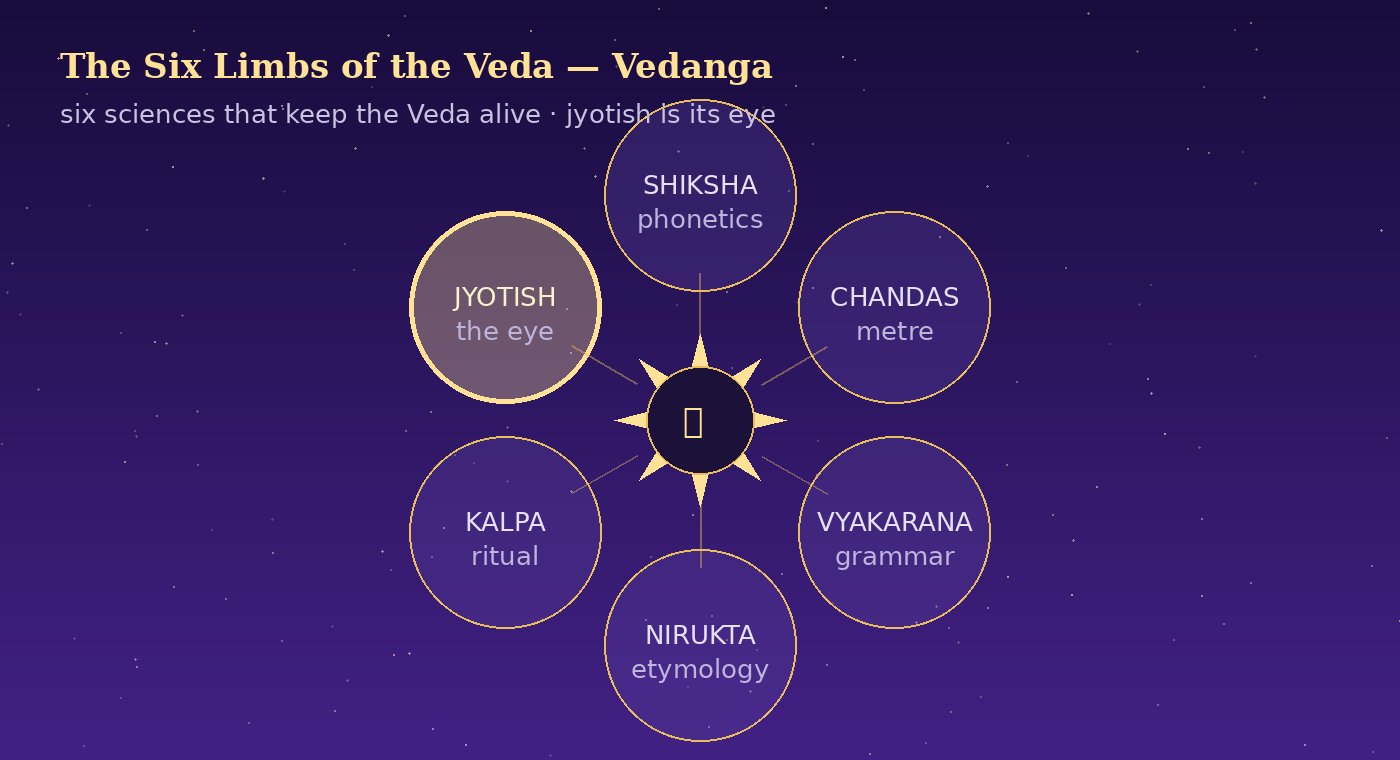
Three thousand years ago, the knowledge of the Veda was guarded entirely by memory. No books, no printing, no search. A single lapse of pronunciation could change a hymn's meaning; a forgotten accent could turn prayer into noise. The rishis who carried this weight understood something profound: wisdom this large cannot survive on reverence alone. It needs infrastructure.
So they built it — six sciences whose only purpose was to keep the Veda intact. Together these are called Vedanga: from veda (knowledge) and anga (limb). A limb is not decoration; it is what lets the body move. Without the six angas, the Veda could not be heard correctly, chanted correctly, understood correctly, or used correctly in time.
The Six Limbs, One by One
| Limb | Science | What it protects |
|---|---|---|
| Shiksha | Phonetics | The sound itself — pronunciation, accent, breath. The Veda lives first in the ear. |
| Chandas | Metre | The rhythm — the meters (gayatri, anushtubh…) that give the hymns their structure and their memory-hooks. |
| Vyakarana | Grammar | The form — Panini's grammar, one of humanity's greatest intellectual achievements, so the words cannot drift. |
| Nirukta | Etymology | The meaning — why each word means what it means, so interpretation cannot be invented. |
| Kalpa | Ritual | The practice — how, when, and in what order the rites are performed. |
| Jyotish | Astronomy & astrology | The eye. The science of time — when to act, when to wait, what moment carries what quality. |
Why Jyotish Is Called the Eye
The other five limbs preserve the Veda's body. Jyotish alone lets it see. The classical metaphor is exact: a body without eyes is complete yet blind — it cannot find its way to action. Jyotish is the eye because it answers the question every other science leaves open: when?
The Mundaka Upanishad, one of the oldest texts to mention the angas, describes them as the wings that carry the knower upward — and tradition has long singled out the eye among the limbs. To know the Veda's words is one thing. To know the moment in which a word becomes an act — a marriage, a sowing, a naming, a beginning — that is jyotish.
And notice what the six limbs together quietly prove: the tradition never separated knowledge from timing. Phonetics, grammar, ritual — all of it is precise engineering for meaning. Jyotish is the same engineering applied to time itself. The panchang, the tithi, the muhurta, the dasha — these are not superstitions that grew around the Veda. They are the Veda's own method, applied to the sky's clockwork.
Why We Took This Name
When this project began, the question was not "what should we call it?" but "what do we believe?" The answer: that the eye of the Veda was built for everyone. For three millennia it was guarded by families, lineages, and — in our era — by paywalls and fear-based marketing. A science this carefully engineered for precision deserved a better gate than that.
getVEDANGA reads two ways, deliberately. Vedanga — the six limbs, the inheritance we work within: our desk follows the same disciplines of precision the shikshakas and vyakaranis demanded of sound and grammar. And get Vedanga — an instruction: take it. The eye of the Veda belongs at every kitchen table where a family is choosing a wedding date, at every hospital ward where a child is being named, at every midnight when someone opens a phone and asks the sky a question.
So every tool on this site — the kundli engine, the 36-guna matching, the panchang, the tarot of the day — is built in that spirit: the discipline of the six limbs, offered freely. No login. No paywall. No fear for sale. If the rishis built the eye to serve the Veda, we are building it to serve the reader.
The body of knowledge was never the hard part. The eye was. Keep it open.